

Scroll Down
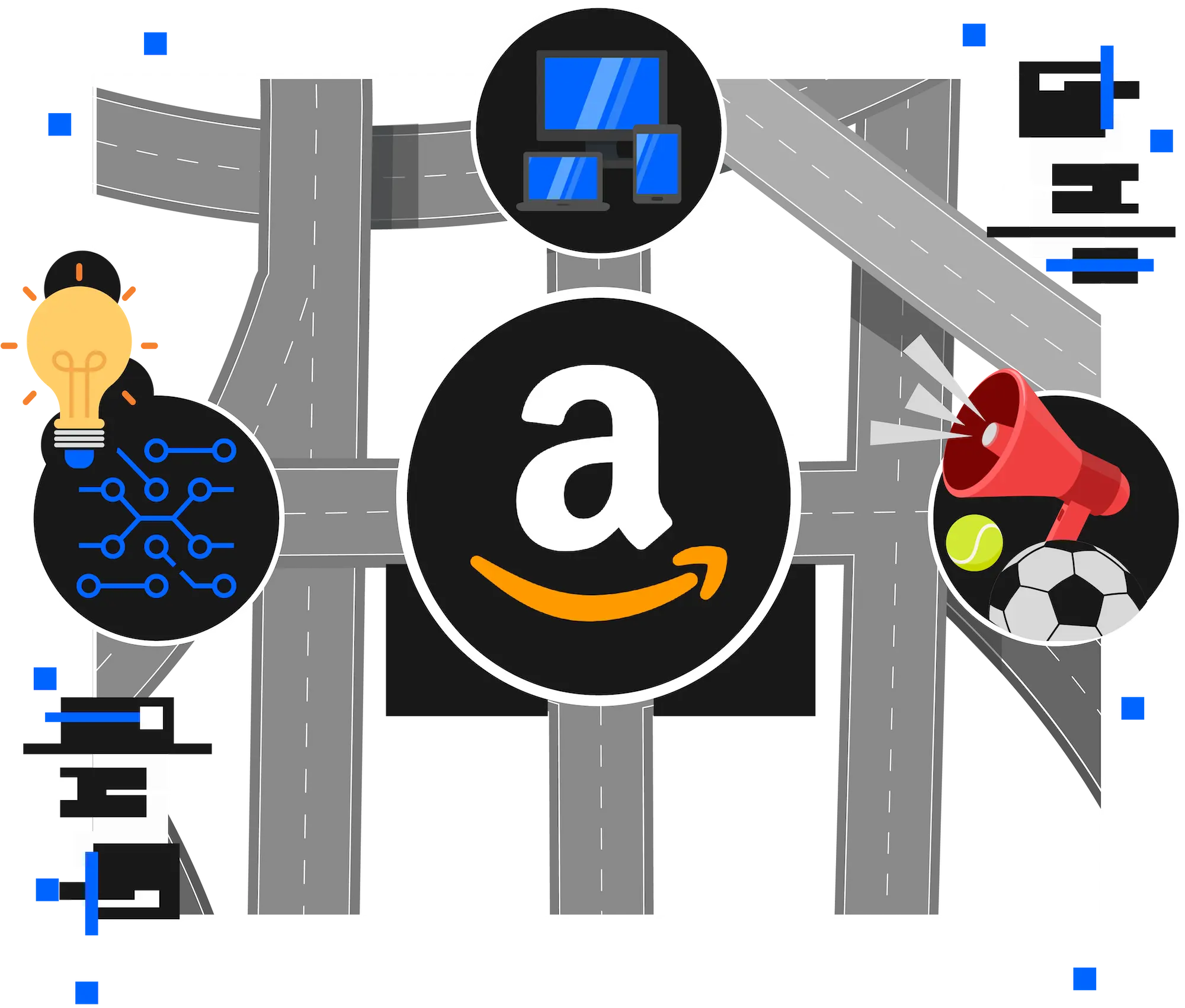
Do all roads lead to Amazon?
Ten years ago, Amazon’s involvement in sport appeared minimal.
There was a lost bid to Twitter for NFL rights (acquired by Amazon the next year) and AWS revenue sat at $4.6B and Amazon at $89B, minimal compared to today (per their 2024 Letter to Shareholders). Amazon was laying their foundation by investing in cloud infrastructure, data integration, and AI capabilities.
Author: Ashley Shaner
Scroll Down
Fast forward to the brink of 2026 and Amazon now stands at the intersection of fan experience, media rights and tech innovation across the sports value chain – from data-driven production tools to global live streaming infrastructure, retail integration, and audience monetization.
Fans can purchase merchandise, consume content, receive personalized recommendations and stream live events with minimal friction, all underpinned by the AWS tech stack.
Largely invisible to fans, this trend runs on data infrastructure, machine learning, and generative AI tools that are driving new levels of efficiency and creativity. For those on the tools, their day is being simplified and elevated. Examples include:

Formula 1
Leveraging AWS generative AI to mine historical data, feeding predictive storytelling and broadcast features such as Statbot.
The NFL
Utilizing computing power to generate its season schedule from over one quadrillion possible permutations, optimizing competitive balance and broadcast value.

Bundesliga
Employing on-pitch camera systems that process data in real time, producing the “Pressure Index” on-screen visualization for live broadcasts.
These capabilities illustrate how cloud infrastructure and AI are reshaping sports operations from production workflows to content personalization to predictive insights.
Amazon’s partnerships with major leagues and federations – including the likes of the NFL, NBA, WNBA, and UEFA – have also redefined the commercial landscape. Sports content has become central to their advertising ecosystem, enabling brands to reach highly engaged audiences, benefiting both Amazon and rightsholders. NFL coverage over three seasons added 70 new advertisers, equating to new revenue.
Amazon’s journey in sport has not been without challenges. Ongoing concerns around piracy via Fire Stick devices highlight the complexity of digital distribution at scale and work that still needs to be done. Similarly, early attempts to merge the Twitch community with live sports content failed to deliver sustainable engagement. AWS has rare but non-zero outages, showing that backbone tech is not immune to errors.
Today, Amazon is not just a broadcaster or a retailer, but rather the tech infrastructure powering sports. It enables rightsholders, broadcasters, and fans to operate within one connected environment – built on data, cloud computing, and AI. Amazon’s ability to integrate technology, commerce, and content at scale is changing how fans consume sport – from literal delivery to your door to digital delivery through smart speakers, broadcast and voice assistants. Rightsholders need to begin to work more directly with them because they can’t afford not to.

Define a clear strategy for Amazon & AWS
Your organization should already have a clear and forward-looking digital strategy far beyond just social engagement. Digital does not equal social.
With the breadth of Amazon and AWS offerings, a platform-specific approach is now essential and complementary to how you look strategically at many areas of your business. This platform approach should also answer the question of what you want to use the suite of products for. Infrastructure? Innovation? Commercial? Content? This leads to a mapping of not just current capabilities but also the aspirational ones. Even if the outcome is to use another provider in some functional areas, it will provide a clear path of where the gaps lie.
With the rapid evolution of the Amazon ecosystem, it also clearly needs to reflect the interconnectedness of humans and technology and where one can be dialed up or down for greater benefit. AWS provides AI and machine learning tools that can revolutionize how many roles and organizations are using analytics, commentary, fan interaction, and even critical decision making that can provide long term competitive advantage.

Don't overlook data, governance and IP in the AI era
Working with Amazon and AWS provides access to powerful streams of audience and behavioral data, but it also introduces new layers of complexity in ownership, governance, and compliance. This data can drive commercial growth and fan insight, but only if rightsholders clearly define how it is captured, shared, and protected.
As Amazon’s cloud and AI tools underpin more digital operations, rightsholders need to ensure their organization is prepared for evolving privacy regulations, AI ethics, and IP rights management. Robust governance frameworks and contracts are essential to protect both your data and your content, not just with Amazon but with any other platform as well.
Taking one piece of AI generated content as an example. This could be created with a variety of tools, Adobe, Sora, etc. Rightsholders need to be prepared to answer questions and put safeguards in place around who owns the content, how the AI model was trained and was it done with the appropriate permissions in place and even more broadly, how does this impact your reputation and relationship with consumers. If approached incorrectly, your thirty second piece of content could pose more risk than reward. Amazon has also launched a Brand Registry program that helps to protect and report IP infringement, currently more focused around storefronts, but not a requirement.


Rethink your global content for the ecosystem
Tapping into Amazon provides unprecedented reach to a truly global audience. As we know from our work and trends from previous years, traditional “one size fits all” content models no longer apply. It demands a rethink of how content is created, distributed, and monetized.
What performs well on your owned channels may not resonate and have the same impact or demand within Amazon’s environment. To engage with the user base, you need to consider tapping into their tools that are offered through the likes of AWS to deliver tailored fan experiences like personalized highlights, interactive broadcasts or localized content. This is especially true as Amazons commerce-first ecosystem blurs the line between content, commerce, and advertising.
By building content strategies around the strengths of Amazon and AWS, rightsholders can move beyond simple distribution and start creating connected experiences that deepen fan engagement, drive new revenue, and scale globally.
